Showing posts with label Russia. Show all posts

Saturday, 5 October 2019

A visit to the Khatyn Memorial Complex


I remember in my youth watching the television documentary series "The World at War", it was a broad ranging look at events of the Second World War. For some reason, perhaps because it was covered in episode 1, the description of the massacre at the French village of Oradour-sur-Glane by the Waffen SS made a lasting impression. A decade later in 1984 I was travelling south through France on holiday and happened to see a signpost for Oradour-sur-Glane and detoured to visit the village. The original village is now a permanent memorial and museum, a new village was established nearby. The visit fixed the village of Oradour-sur-Glane permanently in my memory.

Fast forward 35 years and I am on holiday again, this time visiting Belarus. When I am travelling I tend not to research where I am going so that I can be surprised, serendipity is what I like about travelling. After four days exploring Minsk it was time to start seeing some more of the country, the first place I visited was Khatyn (Хаты́нь).
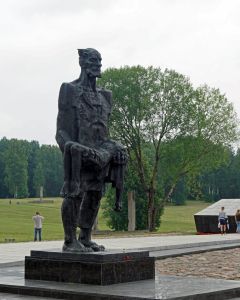
“The Unconquered Man”

State Memorial Complex Khatyn


The memorial complex is located on the site of what was once a small Belorussian village. On 22nd March 1943 the inhabitants of the village were massacred by brutal fascists, all the adults and all but three of the children perished. Unlike Oradour-sur-Glane in France the village was never reoccupied. I won't go into the details of what happened on that spring day in 1943, I could never adequately describe what happened, the events are fully described elsewhere (e.g. Memorial Complex Web site).

As bad as these events are, there was much more to discover. Khatyn was not one of a kind, more than 600 villages suffered the same fate - complete annihilation of the population and destruction of the villages, 186 of those villages, like Khatyn, were never reoccupied. In total more than 5,000 settlements were destroyed along with a large section of their inhabitants.

The complex has a number of different memorials including the specifics of Khatyn and the other villages that suffered total annihilation. There is also a memorial for all the victims that suffered in the concentration camps located in Belarus.

Belarus, or Byelorussian Soviet Socialist Republic (Byelorussian SSR) as it was during The Great Patriotic War, suffered enormous casualties, around two and a quarter million people died - 25% of the population.

Khatyn (Хаты́нь) cf Katyn (Катынь)


When I heard about a visit to Khatyn I thought that the name seemed familiar and recalled a massacre taking place, mass executions of Polish military officers by the Soviet Union early in the war. My memory was faulty, Khatyn was as described above. However, I later discovered that my memory was not badly at fault, simply my inability to distinguish the Russian pronunciation of two similar names. There were indeed mass executions of Polish military officers but they had taken place but in the Katyn forest a couple of hours drive east and just over the border in Russia! If you want to know about that massacre take a look at the Katyn Memorial Web site.

Monday, 8 July 2013

Asian Russia

From Trans-Russia 2013

Ekaterinburg


After a journey of a little over 25 hours my train (TR #60) and I arrive in Ekaterinburg (Екатеринбу́рг).

The journey from Moscow was uneventful but I was surprised that we seemed to gain little elevation during the whole trip even though we had crossed the Ural mountains to arrive here at Ekaterinburg, the capital of the Urals region. It seems that the southern section of the Ural mountains are quite low.

Konstantin, the proprietor of the KGB-Hostel I would be staying at while in Ekaterinburg was waiting to meet me at the station. He asked if it would be ok if we took a diversion so that he could get an injection for Japanese encephalitis as he had had an encounter with a tick while walking in the forest earlier in the day. It turns out that there is a significant risk of Japanese encephalitis and Lyme disease in the forests around here. (Note to self!)

The hostel is well situated and once inside the rooms are excellent.

Ekaterinburg has an interesting history and is very different from both St Petersburg and Moscow. It was founded in 1723 and became known for the exile of the Tsar along with his family and their subsequent execution. It also gained prominence during World War II when many facilities were relocated from western Russia.

From Trans-Russia
I was only planning to be in Ekaterinburg for a few days and decided not go anywhere that I could not walk to. To orient myself to the city I decided to walk the «Red Line», a 5.5kms circular walking route around the center of Ekaterinburg. The «Red Line» is literally a red line drawn directly on the footpath surface. Once you are on it, it is hard to lose your way, except in a few places! The accompanying map identifies 35 architecture sights, historical places and unusual monuments.

One of the sights is "The Church on Blood in Honour of All Saints Resplendent in the Russian Land" which stands on the site of the Ipatiev House, where the the last Tsar and his family were executed. The main Russian Orthodox Church was consecrated in June 2003, 85 years after the executions took place. The church was built to commemorate the Romanov sainthood.

From Trans-Russia 
The Military Museum has examples of military hardware produced in the local factories, in front are Katyusha rocket launchers, tanks and an SA 2 (С-75). Presumably the closed city of Ekaterinburg with its factories and military bases was part of what U2 spy plane pilot Gary Powers was spying on when he was shot down nearby by a locally produced surface-to-air SA 2.

Afganistan War Memorial...     From Trans-Russia
With the ever present reminders of "The Great Patriotic War" it is easy to forget that the Soviet Union was involved in other conflicts. There was a large memorial dedicated to another, more recent, conflict was which did not end well, i.e. the Afghanistan War. A great many people were visiting the memorial as well as lots of fresh flowers while I was there.

The longest of my train journeys...


This leg of the journey included 3 nights on the train (TR #340). I am getting used to the routine now and settle into my upper bunk in a 4-berth sleeper. My three fellow travellers are all Russian, one elderly lady and a young couple. The train leaves at its scheduled departure time of 22:20 (local time) and as soon as we are underway it is time for a celebration. It took me a while to figure out what was going on given the language barrier but it seems that today was the young lady's birthday and her husband had brought along food and drink to celebrate. We ate snacks and drank Russian Cognac (not vodka!). I slept well.

In the morning we were continuing to get to know each other when the carriage provodnitsa arrives with breakfast for my three companions. There is lots of spirited discussion and off she goes. After a while she returns and hands me a breakfast. This was a surprise to me, I hadn't booked or paid for a breakfast with my ticket but my fellow travellers didn't let that stop them! The same pantomime played out each morning.

With about 80 hours to pass we slowly get to know something about each other and to enjoy the company. By the time we arrive in Irkutsk I am sad to leave them as they continue to Vladivostok.

Irkutsk


Today Irkutsk (Иркутск) is a large industrial city though it is still one of the largest suppliers of furs to the world markets. The size of the modern city wasn't really apparent to me since I was staying in the historical center of Irkutsk and only visiting places I could walk to (with one significant exception).
I was staying in a private home near Rossiyskaya ulitsa. My host was a lovely lady who spoke German and a little French, both which I can get by in. Every day she prepared a huge breakfast and we spent an hour or so chatting and all the time teaching each other some Russian and English.

contemporary wooden building...     From Trans-Russia
I spent a couple of days wandering aimlessly soaking up the atmosphere of this strange place, I may have been in Siberia since crossing the Urals several days ago but Irkutsk is a very long way from anywhere and unlike anywhere I have been before. The infrastructure has to deal with seasonal variation in weather that is enormous. Irkutsk may be towards the southern edge of the Taiga but there are still countless trees in the millions of square kilometers of forest. Buildings were traditionally built of timber and there are still lots of traditional wooden buildings as well as more recent grand buildings in the Soviet style. There are even contemporary wooden buildings inspired by tradition!

One of the reasons I wanted to stop at Irkutsk was to visit Lake Baikal. Even before I arrived in Irkutsk I had come to the realisation that I had not allocated sufficient time to do the job properly. Like everything in Siberia the lake has some impressive statistics associated with it. It is the world's deepest lake, the largest freshwater lake by volume, the world's oldest lake, and the seventh-largest lake in the world by surface area.

It is about 75km to Listvyanka on the west bank of Lake Baikal so I board a Marshrutka (minibus) that takes me all the way. I spent a few hours walking by the lake from Listvyanka which was all I could manage with the totally inadequate amount of time available to me. While at Lake Baikal is saw something I had not seen anywhere else in Russia, namely, CCCP emblazoned on a small speed boat.

The return journal should have been simply a matter of reversing the journey. After getting on the bus successfully we returned to Irkutsk... BUT, after travelling through unfamiliar parts of Irkutsk I realised that we were not going back to the bus station I had left from! I jumped off the Marshrutka at the first opportunity and figured a way back to my accommodation.

Friday, 28 June 2013

European Russia: Part 2

Taking just a little more than 7 hours, my train journey from St Petersburg is a short, comfortable and uneventful journey, the only downside being that I arrive at Moscow Oktiabrskaia station at 05:15. Someone was waiting for me at the station and took me to my hotel. Along the way we passed a dramatic sight which I missed the opportunity to photograph. The sun was just rising, the sky was red and Monument to the Conquerors of Space looked spectacular.

No hotel problems in Moscow, I stayed at the very pleasant Hotel Zarya north of central Moscow but just a few stops away on the Metro. I was able to grab a couple of hours sleep before breakfast giving me a full day to start exploring Moscow.

The nearest metro station was Vladykino (Владыкино). I bought tickets for 5 rides for only 150RUB, and one ticket takes you anywhere on the Moscow metro, one price, no zones, the best value item in Moscow. I take a simple journey with no changes to Borovitskaya (Боровицкая) which I later discovered is geographically located in the very centre of Moscow. As you emerge from the station on to Mokhovaya Street the towers of the Kremlin (Моско́вский Кремль) are impossible to miss as you look east.

From Trans-Russia 2013
Although the Kremlin is just a short walk east of the station I decide to head south for a bit to see if I find anything interesting in the knowledge that I can always return to the Kremlin. I hadn't walked far when the golden dome of the Cathedral of Christ the Saviour (Храм Христа Спасителя) came into view. I spent some time walking around the grounds of this spectacular church before taking the footbridge across the Moskva River (река Москва) to an island -- Balchug -- …

After wandering most of the day the sky became increasingly threatening so I decided to make my way towards the public entrance to the Kremlin. The queue to enter suggested that there were likely to be was more people inside than I wanted to deal with, and I do hate queueing. So I continued walking through the Alexander Gardens to Manezhnaya Square and then into Red Square (Красная площадь). While Red Square is a large space, it is not as big as I had expected based on all the footage I had viewed over the years. While in the square there was a cloud burst and a torrential downpour, the first real rain I'd seen in my weeks of travelling.

GUM, from Trans-Russia 2013
I took the rain as a cue to visit GUM (ГУМ) and sit out the storm with a coffee. Like all the places I'd seen in central Moscow, GUM was pretty amazing, and seemingly a world away from images formed during the Soviet era!

My second day started out much like the first, this time I was planning to visit some of the metro stations with a view to their architecture rather than location. The first station I visited was Arbatskaya since it was one of the stations that intersected  9  from Vladykino. I visited several other stations including Oktyabrskaya and Mendeleevskaya.

From Trans-Russia 2013
I managed to spend some time in Gorky Park (Moscow) and nearby Fallen Monument Park. Unfortunately there was extensive landscaping work taking place in Fallen Monument Park so many of the iconic statues were not to be seen, still worth a visit though.

I continued my Drunkard's Walk and as the sun was setting I found myself in the Tverskoy District, north of central Moscow. Time to get the metro back to my hotel.

Two days is certainly not long enough to see any significant fraction of what Moscow has to offer. That said, I did enjoy my time here and would certainly recommend Moscow as a city to visit. Much more interesting than one-dimensional Leningrad!

TR #60
TR #60 from Trans-Russia 2013
I did experience one wrinkle in my travel arrangements while in Moscow. When I booked my train I was scheduled to leave Moscow from Yaroslavsky station, the western terminus of the Trans-Siberian Railway. When I collected my tickets it turned out that I would actually be leaving on TR #60 from Kazansky station (Казанский вокзал‎)! I faffed about a bit at Kazansky trying to find the platform but no great problem.

Monday, 24 June 2013

European Russia: Part 1

I was woken from a deep sleep by an officious, uniformed woman. I'm not always quick at becoming alert in the morning but on this occasion I instantly realised that this was a Russian border official and that she was holding my passport in her hand. Good news, all is ok and I can proceed on my train journey into Russia. It is a little after 04:00 and the border process with Latvia had only taken 4 hours.

After a couple more hours on the train I arrived at Vitebskii station in St Petersburg. I'm collected at the station by a driver and taken to the Apple Hostel where I'm told that I cannot get my room until 13:00 but that I'm welcome to take a shower while I wait. I get talking to an Australian woman who's been here a couple of days and accompany her on an errand to the Mariinsky Theatre to orient myself a little in the city.

When I return I'm told that they actually do not have a room for me and that they've booked me a room in the Retro Hostel and handed over 3600RUB refund. I  am  not  happy! I'd pre-booked a walking tour of the city with the same people who booked me the room here and I was due to meet them here at 14:00 so waited. When the guide came she was appalled at what had happened and spoke for a long time with the hostel to no avail. She then spoke to her boss to book me a room elsewhere and in the meantime walked with me to the Retro Hostel where I dumped my bag before taking the tour. By the end of the tour they had not succeeded in finding me another room that night but did get me a nice one for the night after.

The Retro was good value for money at only 500RUB but by 03:00 there were 12 people in the 10 person dorm. I was not sad to leave.

From Trans-Russia 2013
I included St Petersburg in this trip since we'd considered it as a honeymoon location, but went elsewhere, and in all the years since had never got around to visiting. Some people I know who have visited speak well of the city so I decided it would just be a small extension to my trip. At first the city lived up to my expectations. Since the city was planned to be a European style city much of the architecture was familiar, the only real exception being The Church of Our Savior on the Spilled Blood, built very much in a Russian Style. I've been told that the church is unpopular with some local people for this very reason.

By the end of my time in St Petersburg I had come to dislike this planned, European style. While whole streets of the building look very grand, Nevsky Prospect being the prime example, behind the façade there is often a run down tatty reality. All three places I visited for accommodation fell into this category. Once through the façade there were worn, crumbling dark staircases leading to individual residences that could be delightful behind yet more steel doors. The planned uniformity also gives the city a one dimensional feeling, most cities are an interesting blend of architectural styles, not so with St Petersburg.

Hermitage
HermitageFrom Trans-Russia 2013
This is not to say that St Petersburg is not worth visiting or that there are no attractive features. I took the opportunity to visit the Hermitage Museum and while for me it didn't meet my admittedly high expectations it was indeed an impressive museum. Unfortunately, the one section closed off for renovation included the one and only piece that I specifically wanted to see!

It was a lively time in St Petersburg with University Graduations taking place, part of the reason finding a room was difficult, and public concerts celebrating the longest day.

St Petersburg is built on a number of islands in the delta of the River Neva which should have warned my about the likelihood of insects. On my last night in the city it was hot and humid and my bedroom window was open… and in the morning I was covered in hundreds of mosquito bites!

I leave from the St Petersburg Moskovsky railway station headed for Moscow on the night train Tr #29…

Saturday, 22 June 2013

Home to Russia: Part 5 and retrospective

The last leg in this journey is by far the shortest but the end point is also where I am most likely to encounter a serious problem, i.e. a problem with my Russian Visa.

I'm getting ahead of myself, so back to Riga where I am scheduled to catch train 038P. So that I am not surprised by anything on the day I pop into the station the day before to see what would happen. I enter the station and then walk down the tunnel that leads to all the platforms. Platforms and tracks here are synonymous (unlike Poland) and come in pairs 1;2, 3;4, 5;6, 7;8. ... the end, where is platform 11? I go back to the station and eventually find that platforms 10;11;12 are reached from platform 1, obvious?

This kind of wrinkle is why I recce'd the day before. The train was at the platform half an hour before departure allowing plenty of time to go through the checks at the carriage and board. Looking good.

From Trans-Europe 2013
On the day I head straight to the platform and down to carriage 13 to board, I've an electronic ticket so no paper just my ID (passport). No luck, my ID is not on the list. To be on the safe side I'd printed Russian and English versions of the ticket but still no joy, if your name is not on the list you do not get on. Tension is rising...

I call my agent in London who booked the tickets and they confirm that there is indeed an electronic ticket and I hand over the Russian speaking agent to the ticket clerk, still no joy. I'm not on their list so I do not get on. Time passes, tension continues to rise...

I'm told I need to go to a ticket desk and get a paper ticket, so off I rush. When I get to the counter I'm fortunate to find three Russians in the same state that I am and the counter staff do something and tell us all to go. 5 minutes to get back to train, running up steps and along to platform with 20kg rucksack warms me up a little. When I get back to carriage 13 I wait 2 minutes and a new list appears and I'm on it! I climb aboard find my bed and before I can sit down we're off. That was close.

One of my fellow travelers in the compartment was one of those like me not on the list. His name was Alex and he speaks English. The other occupant of the compartment was a Russian that didn't speak English.

We have six hours travel ahead before we reach Karsava and the border, we should arrive a little after midnight. The shaky start to our trip gives plenty of reason to engage in conversation. Alex works for a Russian telecoms company and has traveled extensively in Europe and North America as well as to Ukraine and Belarus. As student he worked in the UK on a farm for several months. Our fellow traveler was a retired member of the Russian Navy. While he now lives near the Latvian border he served in the Arctic and out of Vladivostok. The rain had internet connectivity and we did some sharing of photos of places we had each visited. Alex had lots of photos of his time in UK and still keeps in touch with the farmer he worked for. They were keen to see my photos of Central Asia and Iran, places they knew little of.

Conversation could sometimes be slow with Alex acting as interpreter but it was a pleasant evening and the time went quickly. We arrived at the Latvian border and formalities for me were quick and painless, they were little more onerous for the Russians. We then traveled through no mans land for several minutes before arriving at the Russian border post. Things were not so simple here, procedures took another 3 hours before reaching their conclusion...


Retrospective


When planning this journey I only had one fixed point, the start. I had a choice of endpoints, St Petersburg or Moscow and eventually came to the decision that if I was going to visit Russia I might as well visit St Petersburg as I'm unlikely to do it at a later date. With fixed start and end points I could start on a route. The route as far as Warsaw was straightforward but then there were choices to be made. There were three "countries" to consider along the way that I have never visited, Lithuania, Latvia and the Russian enclave of Kalingrad. Train travel in this area is not straightforward and the added complication of needing a double entry Russian visa I decided on a route from Warsaw via Vilnius (Lithuania) and Riga (Latvia) to St Petersburg. In retrospect I think it would skip Vilnius and go for Kalingrad.

The journey east was a journey from the familiar to the increasingly unfamiliar. From Cologne onward the terrain changed very little, mostly flat with occasional undulating areas either cultivated with cereal crops of covered in forest. The trains themselves and the track that they run on seemed more like a journey back in time starting with the Eurostar and ICE trains that run at up to 300kph, through slower electric trains that might manage 200kph and finally tired old beasts that rarely exceeded 100kph and averaged much less.

The languages, unsurprisingly, changed from French which I can speak reasonably to German which I can also get by with through to the eastern European languages which I do not speak but at least use the Latin writing system. It will get harder as I continue my journey and have to contend with Russian and the change to the Cyrillic script.