Showing posts with label Travel. Show all posts

Thursday, 12 May 2022

Rivers don't always run to the sea.

In 2007 I was travelling through Kyrgyzstan when I discovered that one of the the lessons I was taught in geography at school was wrong. I noted the mistake in my description of the journey but only recently learnt that there is terminology to describe the feature. In my journey log I noted:

We also travelled near the Chuy River (pronounced: "chewy") which our guide said was the second longest in Kyrgyzstan. In one respect this river was unlike any I had seen or heard of. I have always thought of rivers as rising in high ground and eventually finding their way to the sea. However, the Chuy River flows into Kazakhstan where it eventually disappears in the steppe.

Recently, I was reading an article which referred to an endorheic basin. Briefly, an endorheic basin is the end point of a rivers flow which is not another river or an ocean. This "unusual" feature of the Chuy River was explained to me when I was near the rivers origin in the Kochkor District of Kyrgyzstan. It then flows for more than 1000km through Kyrgyzstan and Kazakhstan where it eventually fades away into the steppe a little short of the Syr Darya River which flows to the Aral Sea (an endorheic basin). The Chuy is still unusual in the sense that it doesn't end at a body of water. It also passes withing a few kilometers of Issyk-Kul, an endorheic lake in Kyrgyzstan.

I have spoken to several people who also recall being taught this fallacious fact. I suspect that it is a true statement about rivers in England, and maybe even the United Kingdom but I do not remember any such qualifier when it was taught to me.

Postscript after a 16 year gap I recently returned to Uzbekistan to pick up the journey I had suspended in Tashkent and continued west through Samarkand, Bukhara and Khiva. While travelling between these cities we had cause to cross the Amu Darya river (historically known as the Oxus) and I learned due to the large-scale diversion of water it no longer reaches its historic terminus in the Aral Sea. This is part of why the Aral Sea is shrinking but it also means that, like the Chuy, the Amu Darya river just fades away into the desert. July 2023.

Saturday, 5 October 2019

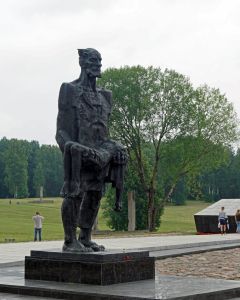
A visit to the Khatyn Memorial Complex


I remember in my youth watching the television documentary series "The World at War", it was a broad ranging look at events of the Second World War. For some reason, perhaps because it was covered in episode 1, the description of the massacre at the French village of Oradour-sur-Glane by the Waffen SS made a lasting impression. A decade later in 1984 I was travelling south through France on holiday and happened to see a signpost for Oradour-sur-Glane and detoured to visit the village. The original village is now a permanent memorial and museum, a new village was established nearby. The visit fixed the village of Oradour-sur-Glane permanently in my memory.

Fast forward 35 years and I am on holiday again, this time visiting Belarus. When I am travelling I tend not to research where I am going so that I can be surprised, serendipity is what I like about travelling. After four days exploring Minsk it was time to start seeing some more of the country, the first place I visited was Khatyn (Хаты́нь).

“The Unconquered Man”

State Memorial Complex Khatyn


The memorial complex is located on the site of what was once a small Belorussian village. On 22nd March 1943 the inhabitants of the village were massacred by brutal fascists, all the adults and all but three of the children perished. Unlike Oradour-sur-Glane in France the village was never reoccupied. I won't go into the details of what happened on that spring day in 1943, I could never adequately describe what happened, the events are fully described elsewhere (e.g. Memorial Complex Web site).

As bad as these events are, there was much more to discover. Khatyn was not one of a kind, more than 600 villages suffered the same fate - complete annihilation of the population and destruction of the villages, 186 of those villages, like Khatyn, were never reoccupied. In total more than 5,000 settlements were destroyed along with a large section of their inhabitants.

The complex has a number of different memorials including the specifics of Khatyn and the other villages that suffered total annihilation. There is also a memorial for all the victims that suffered in the concentration camps located in Belarus.

Belarus, or Byelorussian Soviet Socialist Republic (Byelorussian SSR) as it was during The Great Patriotic War, suffered enormous casualties, around two and a quarter million people died - 25% of the population.

Khatyn (Хаты́нь) cf Katyn (Катынь)


When I heard about a visit to Khatyn I thought that the name seemed familiar and recalled a massacre taking place, mass executions of Polish military officers by the Soviet Union early in the war. My memory was faulty, Khatyn was as described above. However, I later discovered that my memory was not badly at fault, simply my inability to distinguish the Russian pronunciation of two similar names. There were indeed mass executions of Polish military officers but they had taken place but in the Katyn forest a couple of hours drive east and just over the border in Russia! If you want to know about that massacre take a look at the Katyn Memorial Web site.

Monday, 26 November 2018

The eating of insects

I first sampled "insect as food" back in 2002 when I was visiting Hua Hin in Thailand. I seem to recall that they were crickets and quite enjoyed them.

Fast forward to 2018 and I am yet again in Southeast Asia, this time I am in Cambodia when I encounter "insect as food". I didn't see insects for sale until I reached the tourist hotspot of Siem Reap. Wandering around the Night Market there were lots of vendors selling individual exotic insects, and arachnids, to the tourists. I saw lots of examples of small groups of tourists, most frequently young males, egging each other on to eat a tarantula or scorpion. The amount paid varied wildly since there were no prices, the cost was determined by how much the vendor could get away with, capitalism at its finest.

I felt not the slightest temptation to sample the food these vendors were selling. However, I did start thinking about the fact that I had not noticed insects for sale in the the various markets I had visited over the previous few weeks.

A few days after leaving Siem Reap I stopped for a break at a small market about 250km southeast of Siem Reap right on the NR6 highway near Skun. Finally I got to see insects for local consumption rather than for "adventurous tourists". The variety of insects for sale was huge, and unlike Siem Riep where a tourist would buy a single creature and often fail to eat the whole thing, here you could buy them by the kilo.


Here, if all you wanted was an individual exotic insect or arachnid, you could choose a live one and get it cooked to order. With the scorpions you see them remove the sting first. On this occasion I did indulge myself with a deep fried tarantula with garlic. Pretty tasty but I'm not sure it tasted much different to any other deep fried insects with garlic.

Tuesday, 30 October 2018

Reflection on my visit to Cambodia

It is now several months since I visited Cambodia but recently I got around to buying a frame for some artwork I bought while I was there. This action prompted me to think back to when I bought the piece and what motivated me to buy it. With all due respect to the artist this is probably not a great painting it is however a piece of work that I like and a reminder of the events that led to its creation.

In the years following the U.S. withdrawal of troops from Vietnam in 1975 the Khmer Rouge (Red Cambodians), led by Pol Pot, effectively took control of Cambodia which was renamed the Democratic Republic of Kampuchea. A very dark period dawned and the regime set about systematically dismantling the old ways and implementing an extreme form of communism based on peasant powered agriculture. Staples of society such as health care, education, cities, money, religion, families were not tolerated.

So how does a single painting spark these memories? Well, among the plethora of forbidden activities were cultural activities which included art, literature, music… Among the literally millions (estimated ~2million +/- 1 million) of victims of this genocide were pretty much all the artists which destroyed not only the lives of individual artists but the teachers, role models and reservoir of local traditions.

While in Siem Reap I was asked if I was interested in a visit to the circus, at first I wasn't that enthused but my interest was piqued when it was suggested that circus skills were another example of activities that were banned by the Khmer Rouge and whose practitioners had been killed. A short tuk-tuk ride west of where I am staying is Phare, The Cambodian Circus.
Phare, The Cambodian Circus - Siem Reap
It had been a long time since I had been to a circus and had no idea what to expect… I may have started out rather unenthusiastic but after sitting through the performance I was a convert, the entertainment value was outstanding. There were certainly some familiar circus skills displayed as part of the performance but the blend of music, dance, story telling, humour and athleticism combined to give tremendous entertainment.

The common factor between these two examples of Cambodian culture, i.e. painting and circus, is the resurgence of interest and practice in these activities that were almost completely eradicated by the Khmer Rouge regime. More than a simple resurrection of the original practices modern Cambodians have sought help from their neighbours to regain some of the old skills but have also invigorated the old with more modern and experimental techniques. The results may as yet lack polish but are very exciting and even inspire admiration in artistic philistines like myself.

The painting that prompted this post was sold to me by the artist at Preah Ko, a small temple about 15 kilometers south-east of the Angkor temple.


Album

Wednesday, 12 September 2018

"Overtourism"


A new word, overtourism, has started to show up in the travel lexicon. The meaning of the term seems to be pretty self descriptive but has been used in subtly different ways, the proposed definition in the Collins Dictionary is short and pretty good but I prefer the wordier definition used by Responsible Travel.

While in Southern Thailand earlier this year I came across an example of overtourism. We were travelling from Bangkok to Singapore and one our stopping points along the route was Ao Nang, a town on the Andaman coast. Several of our travel companions took the opportunity to visit some of the nearby islands either by kayak or farther away by boat. Without exception everyone who went out to the islands encountered such a mass of tourists that the journeys were considered dismal failures. The problems were not simply the numbers of tourists but the behaviour of a non-trivial minority was sufficient for some to abandon the visit and head back early.

Ko Liao from the sand bar, Ao Nang.
So my earlier experiential claim is not really true, I was fortunate that my wife was unwell for a couple of days and didn't feel up to the required boat travel to get to the islands she really wanted to see. Instead I suggested that we walk north-west along the coast to Nopparat Thara Beach. It would seem that most tourists head off to the famous islands that feature in the must see lists or are not prepared to walk a few kilometers. We enjoyed our walk and found that there were very few people at Nopparat Thara Beach, at low tide you could just walk across to a number of small islands. Just off the beach you can find memorials commemorating those who died in the tsunami on December 26th 2004.

While this modest little beach will hopefully never make on to one of the numerous Places to See Before You Die lists or Top [nnn] Beaches, I would rather spend my time here than at any of the cool places on these lists. To be fair this fascination with lists is not a new phenomenon and I guess this is something else we have to thank the ancient Greeks for since they are the ones credited with compiling The Seven Wonders of the Ancient World.

I may return to this topic at a later date, I have been able to visit some famous sites and avoid the crowds but do I want to share how to do it …

Saturday, 3 August 2013

Back to Europe


The fifth, and final, part of this summer's travels has begun. I'm sitting in seat 1L of an Airbus 330 on Finnair flight 52 from Beijing to Helsinki drinking a very pleasant glass of San Polo Brunello di Montalcino 2005 and looking out the window at the Gobi desert below and thinking how different it looks from 12,000m.

Over the next eight hours I will retrace most of the 12,000km outward journey that took me eight weeks. The real difference between the outward and return legs of the journey isn't the speed, it is the experiences along the way.

I feel oddly relaxed but I shouldn't be surprised since aeroplanes are a familiar environment. I have spent thousands of hours travelling millions of miles in them over the last three decades.

Today will be a long day, I was up at 05:30 (Beijing time) and will not finally stop until I've met up with my wife at Stockholm's Arlanda airport and arrived at our hotel which should be about 22 hours of travel time.

I should pace myself but I think I will also sample the Château Malescasse with my lunch…

Beijing, 2013

My first, and only, visit to China was a short one. When planning this years trip I was presented with the problem of how to get from Ulaanbatar at the end of my Mongolian leg back to Europe. The options were pretty limited:
  • a flight via Moscow, not very appealing especially if it involved Aeroflot
  • a flight via Istanbul, very appealing but only if my final destination was to be London
  • several options via Beijing, not ideal since I would fly the first leg in the wrong direction
However, when looking at the Beijing alternative I discovered that a 72 hour visa free option to visit was introduced this year to encourage passengers transferring at Beijing Capital International Airport to visit the city. Beijing has never been on my list of places to visit but the possibility of visiting for a short period while transferring airlines looked like too good an opportunity to pass up. So, a flight via Beijing is what I decided to do.

I was a little apprehensive about being an early user of the scheme and things did not get off to a good start in Ulaanbatar. When I arrived at the airport to check in for the China Air leg into Beijing my not having a China visa caused my passport, e-tickets for the inbound and outbound flights and hotel booking to disappear for quite a while. After what what seemed likes ages but was in reality only about 20 minutes the documents all came back to the checkin desk and I was allowed to proceed.

In Beijing the procedure was painless, the queue for 72 hour visa free immigration was very short and I was through in a couple of minutes.

I needed to get some local currency but the rates at the airport were terrible plus they charged 60Yuan commission. With what now seemed like prescient foresight I was able to use some of the Yaun I had accepted as a shared taxi payment from someone who had spent all their Mongolian Tigrit.

25Yuan bought me a ticket on the airport express into town another 2Yuan a metro ticket.

From China, 2013
Once again I was having trouble finding my hotel and in desperation stopped at a small eatery -- Little Yunan -- to ask for some help. I was in luck, a couple of patrons looked at my hotel details and while one phoned the hotel for details the other looked it up on their phone. Sorted! I was only a couple of hundred metres away from it. The couple, Coco and Luke invited me to sit while they sorted this out for me and then invited my to have a beer with them which I gracefully accepted. We talked, drank beer, they shared a huge bowl of spicy crayfish, more beer more talk. Three hours later I left for my hotel and they wouldn't let me buy a single drink. If Beijing ever needs any goodwill ambassadors, try Coco and Luke!

My stopover allowed me two days in Beijing. On the first day I started off easy with a leisurely breakfast in my hotel, a wide selection of Chinese food with the addition of fried eggs and a mystery meat. A visit to the bank introduced me to a bureaucratic paper system which eventually resulted in me having enough cash to last me for my visit.

My hotel, The Beijing Shatan Hotel, is very conveniently located less that 500m north of the Forbidden City so decide to strike while the iron is hot and set off for the Forbidden City. The North gate turns out to be the exit, while walking to the entrance at the south gate a thunderstorm breaks. I shelter for a while along the way and set off again when the rain abates. However, the rain soon restarts and by the time it get to the south entrance it is chucking it down again and there are thousands, and thousands of umbrellas with people attached waiting to enter.

I do not like crowds, and I'm not too fond of rain either, so decided to give a visit to the Forbidden City a miss and return at opening the following day.

On the south side of the Forbidden City is Tiananmen Square, a vast area surrounded on all four sides by grand buildings. It too is packed with umbrellas! I give in and slowly wend my way back through The Exquisite Park, a long narrow park that runs runs north /south and which just happens to pass Little Yunan where I stop for a late lunch and a beer.

From China, 2013
My next outing is in better weather and I head for Jingshan Park which is on the north side of the Forbidden City. This is an atractive park in its own right but the hill also affords great views of the Forbidden City to the south as well as views to the north. This time I walk around with a New Zealand couple who are only in town for 24 hours and we get an unobstructed view of the south gate entrance 'cos it is closed.

The crowds have got to me and I spend the rest of my time mooching around quieter areas, eating and drink at small establishments and finally getting my shaggy mop of hair cut before meeting Lyyn in two days time.

The exit procedure at Beijing Capital International Airport is as simple as the entry procedure.


Okay, so this is a pretty brief review of a major world capital city, but it is brief because I cannot say I liked the city very much. I'm glad that I only devoted 2 days of my life to visiting it. The highlight of the visit was meeting Coco and Luke.

Wednesday, 10 July 2013

Mongolian money is a bit of a nuisance

Mongolian money is a bit of a nuisance from a practical point of view, when I changed some British Pounds (GBP) yesterday I got 2,172 Tughrik (currency code: MNT) to the Pound. It isn't that the large numbers are a problem, I can remember when you received millions of Turkish Lire to the Pound, it is the denominations of the notes. The main problem for me is that there are only notes, there are no coins!

The largest denomination is 20,000MNT and the larger denominations are fine but I already find that have some notes as low as 10MNT. I seriously doubt you can buy anything with 10MNT, perhaps I will take them home for use as bookmarks.

Monday, 8 July 2013

Asian Russia

From Trans-Russia 2013

Ekaterinburg


After a journey of a little over 25 hours my train (TR #60) and I arrive in Ekaterinburg (Екатеринбу́рг).

The journey from Moscow was uneventful but I was surprised that we seemed to gain little elevation during the whole trip even though we had crossed the Ural mountains to arrive here at Ekaterinburg, the capital of the Urals region. It seems that the southern section of the Ural mountains are quite low.

Konstantin, the proprietor of the KGB-Hostel I would be staying at while in Ekaterinburg was waiting to meet me at the station. He asked if it would be ok if we took a diversion so that he could get an injection for Japanese encephalitis as he had had an encounter with a tick while walking in the forest earlier in the day. It turns out that there is a significant risk of Japanese encephalitis and Lyme disease in the forests around here. (Note to self!)

The hostel is well situated and once inside the rooms are excellent.

Ekaterinburg has an interesting history and is very different from both St Petersburg and Moscow. It was founded in 1723 and became known for the exile of the Tsar along with his family and their subsequent execution. It also gained prominence during World War II when many facilities were relocated from western Russia.

From Trans-Russia
I was only planning to be in Ekaterinburg for a few days and decided not go anywhere that I could not walk to. To orient myself to the city I decided to walk the «Red Line», a 5.5kms circular walking route around the center of Ekaterinburg. The «Red Line» is literally a red line drawn directly on the footpath surface. Once you are on it, it is hard to lose your way, except in a few places! The accompanying map identifies 35 architecture sights, historical places and unusual monuments.

One of the sights is "The Church on Blood in Honour of All Saints Resplendent in the Russian Land" which stands on the site of the Ipatiev House, where the the last Tsar and his family were executed. The main Russian Orthodox Church was consecrated in June 2003, 85 years after the executions took place. The church was built to commemorate the Romanov sainthood.

From Trans-Russia 
The Military Museum has examples of military hardware produced in the local factories, in front are Katyusha rocket launchers, tanks and an SA 2 (С-75). Presumably the closed city of Ekaterinburg with its factories and military bases was part of what U2 spy plane pilot Gary Powers was spying on when he was shot down nearby by a locally produced surface-to-air SA 2.

Afganistan War Memorial...     From Trans-Russia
With the ever present reminders of "The Great Patriotic War" it is easy to forget that the Soviet Union was involved in other conflicts. There was a large memorial dedicated to another, more recent, conflict was which did not end well, i.e. the Afghanistan War. A great many people were visiting the memorial as well as lots of fresh flowers while I was there.

The longest of my train journeys...


This leg of the journey included 3 nights on the train (TR #340). I am getting used to the routine now and settle into my upper bunk in a 4-berth sleeper. My three fellow travellers are all Russian, one elderly lady and a young couple. The train leaves at its scheduled departure time of 22:20 (local time) and as soon as we are underway it is time for a celebration. It took me a while to figure out what was going on given the language barrier but it seems that today was the young lady's birthday and her husband had brought along food and drink to celebrate. We ate snacks and drank Russian Cognac (not vodka!). I slept well.

In the morning we were continuing to get to know each other when the carriage provodnitsa arrives with breakfast for my three companions. There is lots of spirited discussion and off she goes. After a while she returns and hands me a breakfast. This was a surprise to me, I hadn't booked or paid for a breakfast with my ticket but my fellow travellers didn't let that stop them! The same pantomime played out each morning.

With about 80 hours to pass we slowly get to know something about each other and to enjoy the company. By the time we arrive in Irkutsk I am sad to leave them as they continue to Vladivostok.

Irkutsk


Today Irkutsk (Иркутск) is a large industrial city though it is still one of the largest suppliers of furs to the world markets. The size of the modern city wasn't really apparent to me since I was staying in the historical center of Irkutsk and only visiting places I could walk to (with one significant exception).
I was staying in a private home near Rossiyskaya ulitsa. My host was a lovely lady who spoke German and a little French, both which I can get by in. Every day she prepared a huge breakfast and we spent an hour or so chatting and all the time teaching each other some Russian and English.

contemporary wooden building...     From Trans-Russia
I spent a couple of days wandering aimlessly soaking up the atmosphere of this strange place, I may have been in Siberia since crossing the Urals several days ago but Irkutsk is a very long way from anywhere and unlike anywhere I have been before. The infrastructure has to deal with seasonal variation in weather that is enormous. Irkutsk may be towards the southern edge of the Taiga but there are still countless trees in the millions of square kilometers of forest. Buildings were traditionally built of timber and there are still lots of traditional wooden buildings as well as more recent grand buildings in the Soviet style. There are even contemporary wooden buildings inspired by tradition!

One of the reasons I wanted to stop at Irkutsk was to visit Lake Baikal. Even before I arrived in Irkutsk I had come to the realisation that I had not allocated sufficient time to do the job properly. Like everything in Siberia the lake has some impressive statistics associated with it. It is the world's deepest lake, the largest freshwater lake by volume, the world's oldest lake, and the seventh-largest lake in the world by surface area.

It is about 75km to Listvyanka on the west bank of Lake Baikal so I board a Marshrutka (minibus) that takes me all the way. I spent a few hours walking by the lake from Listvyanka which was all I could manage with the totally inadequate amount of time available to me. While at Lake Baikal is saw something I had not seen anywhere else in Russia, namely, CCCP emblazoned on a small speed boat.

The return journal should have been simply a matter of reversing the journey. After getting on the bus successfully we returned to Irkutsk... BUT, after travelling through unfamiliar parts of Irkutsk I realised that we were not going back to the bus station I had left from! I jumped off the Marshrutka at the first opportunity and figured a way back to my accommodation.

Friday, 28 June 2013

European Russia: Part 2

Taking just a little more than 7 hours, my train journey from St Petersburg is a short, comfortable and uneventful journey, the only downside being that I arrive at Moscow Oktiabrskaia station at 05:15. Someone was waiting for me at the station and took me to my hotel. Along the way we passed a dramatic sight which I missed the opportunity to photograph. The sun was just rising, the sky was red and Monument to the Conquerors of Space looked spectacular.

No hotel problems in Moscow, I stayed at the very pleasant Hotel Zarya north of central Moscow but just a few stops away on the Metro. I was able to grab a couple of hours sleep before breakfast giving me a full day to start exploring Moscow.

The nearest metro station was Vladykino (Владыкино). I bought tickets for 5 rides for only 150RUB, and one ticket takes you anywhere on the Moscow metro, one price, no zones, the best value item in Moscow. I take a simple journey with no changes to Borovitskaya (Боровицкая) which I later discovered is geographically located in the very centre of Moscow. As you emerge from the station on to Mokhovaya Street the towers of the Kremlin (Моско́вский Кремль) are impossible to miss as you look east.

From Trans-Russia 2013
Although the Kremlin is just a short walk east of the station I decide to head south for a bit to see if I find anything interesting in the knowledge that I can always return to the Kremlin. I hadn't walked far when the golden dome of the Cathedral of Christ the Saviour (Храм Христа Спасителя) came into view. I spent some time walking around the grounds of this spectacular church before taking the footbridge across the Moskva River (река Москва) to an island -- Balchug -- …

After wandering most of the day the sky became increasingly threatening so I decided to make my way towards the public entrance to the Kremlin. The queue to enter suggested that there were likely to be was more people inside than I wanted to deal with, and I do hate queueing. So I continued walking through the Alexander Gardens to Manezhnaya Square and then into Red Square (Красная площадь). While Red Square is a large space, it is not as big as I had expected based on all the footage I had viewed over the years. While in the square there was a cloud burst and a torrential downpour, the first real rain I'd seen in my weeks of travelling.

GUM, from Trans-Russia 2013
I took the rain as a cue to visit GUM (ГУМ) and sit out the storm with a coffee. Like all the places I'd seen in central Moscow, GUM was pretty amazing, and seemingly a world away from images formed during the Soviet era!

My second day started out much like the first, this time I was planning to visit some of the metro stations with a view to their architecture rather than location. The first station I visited was Arbatskaya since it was one of the stations that intersected  9  from Vladykino. I visited several other stations including Oktyabrskaya and Mendeleevskaya.

From Trans-Russia 2013
I managed to spend some time in Gorky Park (Moscow) and nearby Fallen Monument Park. Unfortunately there was extensive landscaping work taking place in Fallen Monument Park so many of the iconic statues were not to be seen, still worth a visit though.

I continued my Drunkard's Walk and as the sun was setting I found myself in the Tverskoy District, north of central Moscow. Time to get the metro back to my hotel.

Two days is certainly not long enough to see any significant fraction of what Moscow has to offer. That said, I did enjoy my time here and would certainly recommend Moscow as a city to visit. Much more interesting than one-dimensional Leningrad!

TR #60
TR #60 from Trans-Russia 2013
I did experience one wrinkle in my travel arrangements while in Moscow. When I booked my train I was scheduled to leave Moscow from Yaroslavsky station, the western terminus of the Trans-Siberian Railway. When I collected my tickets it turned out that I would actually be leaving on TR #60 from Kazansky station (Казанский вокзал‎)! I faffed about a bit at Kazansky trying to find the platform but no great problem.

Monday, 24 June 2013

European Russia: Part 1

I was woken from a deep sleep by an officious, uniformed woman. I'm not always quick at becoming alert in the morning but on this occasion I instantly realised that this was a Russian border official and that she was holding my passport in her hand. Good news, all is ok and I can proceed on my train journey into Russia. It is a little after 04:00 and the border process with Latvia had only taken 4 hours.

After a couple more hours on the train I arrived at Vitebskii station in St Petersburg. I'm collected at the station by a driver and taken to the Apple Hostel where I'm told that I cannot get my room until 13:00 but that I'm welcome to take a shower while I wait. I get talking to an Australian woman who's been here a couple of days and accompany her on an errand to the Mariinsky Theatre to orient myself a little in the city.

When I return I'm told that they actually do not have a room for me and that they've booked me a room in the Retro Hostel and handed over 3600RUB refund. I  am  not  happy! I'd pre-booked a walking tour of the city with the same people who booked me the room here and I was due to meet them here at 14:00 so waited. When the guide came she was appalled at what had happened and spoke for a long time with the hostel to no avail. She then spoke to her boss to book me a room elsewhere and in the meantime walked with me to the Retro Hostel where I dumped my bag before taking the tour. By the end of the tour they had not succeeded in finding me another room that night but did get me a nice one for the night after.

The Retro was good value for money at only 500RUB but by 03:00 there were 12 people in the 10 person dorm. I was not sad to leave.

From Trans-Russia 2013
I included St Petersburg in this trip since we'd considered it as a honeymoon location, but went elsewhere, and in all the years since had never got around to visiting. Some people I know who have visited speak well of the city so I decided it would just be a small extension to my trip. At first the city lived up to my expectations. Since the city was planned to be a European style city much of the architecture was familiar, the only real exception being The Church of Our Savior on the Spilled Blood, built very much in a Russian Style. I've been told that the church is unpopular with some local people for this very reason.

By the end of my time in St Petersburg I had come to dislike this planned, European style. While whole streets of the building look very grand, Nevsky Prospect being the prime example, behind the façade there is often a run down tatty reality. All three places I visited for accommodation fell into this category. Once through the façade there were worn, crumbling dark staircases leading to individual residences that could be delightful behind yet more steel doors. The planned uniformity also gives the city a one dimensional feeling, most cities are an interesting blend of architectural styles, not so with St Petersburg.

Hermitage
HermitageFrom Trans-Russia 2013
This is not to say that St Petersburg is not worth visiting or that there are no attractive features. I took the opportunity to visit the Hermitage Museum and while for me it didn't meet my admittedly high expectations it was indeed an impressive museum. Unfortunately, the one section closed off for renovation included the one and only piece that I specifically wanted to see!

It was a lively time in St Petersburg with University Graduations taking place, part of the reason finding a room was difficult, and public concerts celebrating the longest day.

St Petersburg is built on a number of islands in the delta of the River Neva which should have warned my about the likelihood of insects. On my last night in the city it was hot and humid and my bedroom window was open… and in the morning I was covered in hundreds of mosquito bites!

I leave from the St Petersburg Moskovsky railway station headed for Moscow on the night train Tr #29

Saturday, 22 June 2013

Home to Russia: Part 5 and retrospective

The last leg in this journey is by far the shortest but the end point is also where I am most likely to encounter a serious problem, i.e. a problem with my Russian Visa.

I'm getting ahead of myself, so back to Riga where I am scheduled to catch train 038P. So that I am not surprised by anything on the day I pop into the station the day before to see what would happen. I enter the station and then walk down the tunnel that leads to all the platforms. Platforms and tracks here are synonymous (unlike Poland) and come in pairs 1;2, 3;4, 5;6, 7;8. ... the end, where is platform 11? I go back to the station and eventually find that platforms 10;11;12 are reached from platform 1, obvious?

This kind of wrinkle is why I recce'd the day before. The train was at the platform half an hour before departure allowing plenty of time to go through the checks at the carriage and board. Looking good.

From Trans-Europe 2013
On the day I head straight to the platform and down to carriage 13 to board, I've an electronic ticket so no paper just my ID (passport). No luck, my ID is not on the list. To be on the safe side I'd printed Russian and English versions of the ticket but still no joy, if your name is not on the list you do not get on. Tension is rising...

I call my agent in London who booked the tickets and they confirm that there is indeed an electronic ticket and I hand over the Russian speaking agent to the ticket clerk, still no joy. I'm not on their list so I do not get on. Time passes, tension continues to rise...

I'm told I need to go to a ticket desk and get a paper ticket, so off I rush. When I get to the counter I'm fortunate to find three Russians in the same state that I am and the counter staff do something and tell us all to go. 5 minutes to get back to train, running up steps and along to platform with 20kg rucksack warms me up a little. When I get back to carriage 13 I wait 2 minutes and a new list appears and I'm on it! I climb aboard find my bed and before I can sit down we're off. That was close.

One of my fellow travelers in the compartment was one of those like me not on the list. His name was Alex and he speaks English. The other occupant of the compartment was a Russian that didn't speak English.

We have six hours travel ahead before we reach Karsava and the border, we should arrive a little after midnight. The shaky start to our trip gives plenty of reason to engage in conversation. Alex works for a Russian telecoms company and has traveled extensively in Europe and North America as well as to Ukraine and Belarus. As student he worked in the UK on a farm for several months. Our fellow traveler was a retired member of the Russian Navy. While he now lives near the Latvian border he served in the Arctic and out of Vladivostok. The rain had internet connectivity and we did some sharing of photos of places we had each visited. Alex had lots of photos of his time in UK and still keeps in touch with the farmer he worked for. They were keen to see my photos of Central Asia and Iran, places they knew little of.

Conversation could sometimes be slow with Alex acting as interpreter but it was a pleasant evening and the time went quickly. We arrived at the Latvian border and formalities for me were quick and painless, they were little more onerous for the Russians. We then traveled through no mans land for several minutes before arriving at the Russian border post. Things were not so simple here, procedures took another 3 hours before reaching their conclusion...


Retrospective


When planning this journey I only had one fixed point, the start. I had a choice of endpoints, St Petersburg or Moscow and eventually came to the decision that if I was going to visit Russia I might as well visit St Petersburg as I'm unlikely to do it at a later date. With fixed start and end points I could start on a route. The route as far as Warsaw was straightforward but then there were choices to be made. There were three "countries" to consider along the way that I have never visited, Lithuania, Latvia and the Russian enclave of Kalingrad. Train travel in this area is not straightforward and the added complication of needing a double entry Russian visa I decided on a route from Warsaw via Vilnius (Lithuania) and Riga (Latvia) to St Petersburg. In retrospect I think it would skip Vilnius and go for Kalingrad.

The journey east was a journey from the familiar to the increasingly unfamiliar. From Cologne onward the terrain changed very little, mostly flat with occasional undulating areas either cultivated with cereal crops of covered in forest. The trains themselves and the track that they run on seemed more like a journey back in time starting with the Eurostar and ICE trains that run at up to 300kph, through slower electric trains that might manage 200kph and finally tired old beasts that rarely exceeded 100kph and averaged much less.

The languages, unsurprisingly, changed from French which I can speak reasonably to German which I can also get by with through to the eastern European languages which I do not speak but at least use the Latin writing system. It will get harder as I continue my journey and have to contend with Russian and the change to the Cyrillic script.

Thursday, 20 June 2013

Home to Russia: Part 4

This leg is about travelling from Vilnius (Lithuania) to Riga (Latvia). Unfortunately the railway system is not very helpful when it comes to travel between these two capital cities. I did find a route via Daugavpils that would take about 13 hours and require an overnight stay in Daugavpils! And to add insult to injury my onward train from Riga to St Petersburg goes via Daugavpils.

From Trans-Europe 2013
The bus looks a much better option. I book a seat on Lux Express and once again cannot resist the small delta for a first class ticket. Spacious, relaxing, toilet, coffee, snacks, WiFi... whats not to like. An the scheduled journey time is only 4½ hours for the roughly 300km trip. We arrive 30 minutes ahead of schedule.

A wise choice if I say so myself!


72 hours in Riga


The longest stay of the trip so far. I'm staying at Hotel Irina which is right opposite the Riga Central Station and a few minutes walk from all the main tourist attractions. I quickly find that I like this city, while it has obvious tourist attractions they are set amid an interesting lively city that is full of local people going about their business and enjoying the open spaces. The Old Town of Riga may be a World Heritage Site but it isn't a tourist ghetto.

Like many cities in Europe there are a lot of historic places of worship from many denominations. Riga is no exception, in the Old Town alone there must be a dozen or more half a dozen of which are particularly dramatic.

The Old Town isn't just building and squares, there is a lot of green space, perhaps a mile long with Riga City Canal flowing through the various parks. Very relaxing and well maintained.

From Trans-Europe 2013
You do not have to venture far to see a less manicured, but none the less interesting, view of Riga. Just venture south of the railway tracks...     here you can see the unloved Soviet era building, the Latvian Academy of Sciences (Latvijas Zinātņu Akadēmija), reminiscent of the similarly unloved Palace of Culture and Science (Pałac Kultury i Nauki) in Warsaw.

On the other hand there is the vast, bustling Central Market (Centrāltirgus), a mixture of outside stalls and 5 huge buildings built from reclaimed zeppelin hangars.

The largest of these is solely a meat market! That is not to say that there isn't meat being sold in the other hangers, there is, but this one is HUGE!

I managed a second breakfast in one of the halls (sounds like something a hobbit might say), a coffee and a swet something or other cost the princely sum of 0.45Lat (~50p). A small fraction of what you need to pay north of the railway tracks.

Across the Daugava river more signs of modernity are clear to see with the slender Radio and TV Tower looking slightly south and the dramatic National Library just across the river from the Railway Station.

Trans-Europe 2013

Monday, 17 June 2013

Home to Russia: Part 3

Today is another long travel day, planned duration of travel: 9:56 , Changes 2.

The first train of the day (TLK10011) is scheduled to leave Warszawa Centralna at 07:22. I arrive at the station by 07:00 to allow plenty of time to find my platform. The board shows an on time departure from Platform 2 so down I go. Platform 2 (and all the other platforms) have two tracks, which one will be mine? The overhead signs show the train details just before arrival and all the trains have their number on the front a side of each carriage, so no sweat.

Like all my continental trains so far a seat reservation is required, no standing. It is another Inter City (IC) train with carriages similar but just a little shabbier than the one into Warsaw. I share a first class compartment with two others. Yes, first class again, it was only an extra 10€.

We have to cover ~300km on the first leg to Šeštokai which is just over the border into Lithuania. We have to change trains here because of a break-of-gauge, i.e. where the Polish Standard gauge (1435mm) meets the Russian gauge (1520mm).

When the ticket inspector arrives I get some news that there is a change of plan. My timetable from Deutsche Bahn fails to mention that the trains stops at Trakiszki and that we have to take a bus to Šeštokai. At this point there are now only two of us in the compartment and luckily my fellow traveler speaks some English and warns me of what will happen.

This hiccup has a silver lining as it provides an excuse to engage in conversation. It turns out that he a young engineer from Minsk, Belarus, who had been working for a couple of weeks in Warsaw. We talk a little about the mutual difficulties of him as a Belarusian getting visas and the problems for me getting a Belarusian visa. We then have hours to chat about Life, the Universe and Everything else.

Since he was a native Russian speaker I took the opportunity to brush up on pronunciation of my limited vocabulary. He did at least understand every word I said, and I do mean words not sentences :-).

The bus transfer goes well and takes significantly less time than is scheduled for the train journey. We have only managed an average speed of about 50kph.

From Trans-Europe 2013
From here on the trains have a single class of service. The carriage is occupied by several local youths who are playing very loud music that is not to my taste. Luckily this leg of the journey to Kaunas is only about 1½ hours and we even go a little faster, perhaps as much as 60kph!

The final connection time at Kaunas is very short but we make it easily. What a contrast, a nice comfortable, modern double deck train that gets us to Vilnius in 1¼ hours at about 80kph!

I say goodbye to my fellow traveler who is going to spend some time in town before he catching his night train to Minsk and then I walk the short distance to Florens Boutique where I'll be staying for my visit.


A weekend in Vilnius


It is time to slow the pace a little, I have never been to Vilnius before so I plan to spend the weekend here. I'm up early again, there is another hours time difference from Warsaw and walk the short distance to the Gate of Dawn (Aušros Vartai), the only gate remaining of the original nine city gates, and through into the Old Town (Vilniaus senamiestis).

From Trans-Europe 2013
I'm told that there is an interesting bar Apuokas on Subaciaus which is the first turn through the gate. I'm not desperate for a drink but figure it might be easier to find in daylight. As it turns out I didn't find it but the road led my up to The Bastion which provides a good view over Vilnius.

Now that I have left the main route into the Old Town I continue down the hill to look at one of the many churches in Old Town. Saint Ann's Church and Bernadine Monastery is one of the places you are supposed to visit and here I was, the church and the monastery are in two completely different styles. It was pretty lively as there seemed to be a queue of weddings lined up to take place. I had to come back at a later time to get some photos that weren't full of people.

From Trans-Europe 2013
I meandered my way back into the more mainstream areas and eventually decided I needed a coffee. I tried a Coffee Inn, it is a local chain that I rather liked. Reasonable prices, stay as long as you want, free and fast WiFi.

I spent the remains of the days wandering around the Old Town, there really are a lot of churches of different denominations and styles.

In the evening I looked again for Apuokas, it was easy to find when it is open! I managed to get a draft beer of some description which tasted fine. There were no beers in the bar and no list of them and the bar maid was a rather formidable lady who spoke no English ( I speak no Lithuania) but we sorted something out. When I sat down to drink my beer in peace and watch some locals playing darts I saw a menu, pity she hadn't told me there was one. I discovered what beer I had actually bought and ordered a bar snack. I was a really good bar snack, yellow split peas with heavily smoked ham lardons, served hot. I cannot recall ever eating a better beer snack.

From Trans-Europe 2013
I'm up early again on Sunday and decide to visit a different area. I walk straight to the Cathedral and then to climb to Gediminas Castle. It is another good vantage point and provides views back over the Old Town as well as views across the Neris river to the new town. Being early on a Sunday morning there were not many people about but the funicular was already open and there were more people than I like to be around early in the morning.

Actually I'd had enough of touristville for a bit and headed across the river to mooch around the new town. There weren't many people around and after passing some old, neglected buildings I ended up in sparkling, shiny, new, downtown Vilnius. Quite a contrast. I enjoyed a peaceful lunch before heading back to the mêlée I was anticipating in Old Town.

Photos of trip across Europe
I finished all the main sights, visited a different bar, not as good as Apuokas, and called it a day.

I'm booked to leave at lunch time on Monday, the town is much less frenetic than at the weekend. Note to self: avoid weekends! Two days was plenty for Vilnius.

Saturday, 15 June 2013

Home to Russia: Part 2

Once again the day started well, an early breakfast in the hotel set me up and then I take the short walk to the station. I've plenty of time so take a final walk around the Dom and then take my seat on the train. Today's journey is scheduled to be 10 hours with a change in Berlin. When I booked I was given the option of a first class ticket for an additional 10€, which sounded like a good deal, and took it.

From Trans-Europe 2013
First class on an ICE is significantly more comfortable and spacious than 2nd so very happy to have paid the premium. When the ticket inspector looks at my ticket I get some bad news, the ticket is good, but the train will be late getting to Berlin and I'll miss my connection.

I realised when we approached a stop at Bielefeld that this must be the same train that I took all those years ago when as a schoolboy I took the train from Cologne to Bielefeld. Seems that I am retracing some of my steps.

We are on only a few minutes late when we arrive in Hanover and I'm optimistic that they will make up the delay but this hope is dashed. It seems that floods that have been impacting Central Europe are to blame and we travel slowly through some areas of extensive flooding.

From Trans-Europe 2013
We eventually arrive in Berlin Ostbahnhof just over an hour late and my first task is to rebook onto a later train, I'm in luck there are two more today but the earlier one, with a change at Poznań, doesn't get in till almost 10:00pm and the later non-stop doesn't get in until almost midnight.

In the end I opt for the early train with a change, not necessarily a wise choice given my recent experience changing trains, but the ticket lady gives me two tickets so that if I miss the connection I can just get on the later one. I am optimistic that the belt and braces approach will work out.

From Trans-Europe 2013
The train is an Inter City (IC), note the lack of Express in the description, it is not as quick or comfortable as the ICE but not too shabby either.

As we head east from Berlin the train is still travelling through gently undulating terrain but we also travel through extensive forests as well as the familiar farmland of predominantly cereal crops. We pass through more areas of flooding between Berlin and Poznań but it doesn't slow us up and we arrive on time and I manage to make the connection in the 5 minutes available.

As the day wears on each train is slower and less comfortable than the one before. Our destination is Warsaw (Warszawa) which is a long way in the Central European Time Zone and as such sunset is going to be pretty early and I'll be arriving in the dark. While I have learned from my casual arrival experience in Cologne I am always wary of walking around cities I do not know in the dark. Perhaps I'll take a taxi.

We arrive as scheduled and I decide that the station area is light and lots of people are about so I'll walk to my accommodation for the night. I find it quickly and easily. I'm pretty tired and fancy a beer before bed but cannot find anywhere that will accept something other than złoty. Fair enough, but worth a try!


A day in Warsaw

As with Cologne I allowed myself one day in Warsaw. I have also visited this city briefly once before in the winter of 2004 with one of my daughters.

First task was to find a kantor and change some money. Excellent rates of exchange, British Currency Exchanges are a ripoff.
Advice to travelers from Britain: bring Sterling and change it in Poland, you get lots more złoty for your pound.
When last here we only visited the Old Town (Stare Miasto) so I though I would head that way again.

Royal Castle, WarsawFrom Trans-Europe 2013

The whole place was rebuilt after World War II and even when I visited almost 10 years ago I thought it had a bit of a Disney feel to it. In mid-winter it felt a bit Disney, in high summer it seemed even more so! There were enormous crowds, countless tour groups of many nationalities as well as a large number of school groups.

From Trans-Europe 2013
I wandered the sights for a few hours and decided it was time to move on. I did a bit of random rambling before deciding it was time for evening refreshment. I'd seen enough tourist restaurants offering food from around the world or authentic, traditional Polish fare and wanted somewhere away from it all. I found a little hole in the wall place and since I couldn't understand the men, or share a common language with the lady taking orders, I chose what the person ahead of me ordered. It turned out to be veggie, but tasted fine, what else could I possibly want? Hmmm, a beer.

Photos of trip across Europe
Next task was to find a bar, found one nearby that had a sign with one word I understood piwo (beer) and another promocja which I thought might be promotion, and a price of 7złoty. No English, French, Spanish, German speakers so no conversation. Just a couple of nice beers.

Tuesday, 11 June 2013

Home to Russia: Part 1

Day one of what is only the first part of a longer trip starts well but ends a bit on the flaky side.

All starts well when my daughter picks me to take me to Stratford upon Avon to catch the first of many trains. We share a coffee at the station and then I'm really off. I've done quite a bit of research putting this trip together but I try not too over prepare.

When I get to Marylebone Station I have to take the tube to St Pancras Station... there is no tube station called St Pancras! Where the hell is it? I can not remember now how I determined that it is next to Kings Cross station but with that information in hand the journey is simple. The upgraded St Pancras International Station is certainly an impressive blend of the old and the new.

From Trans-Europe 2013
Boarding reminds me of Japan with all the car numbers marked on the platform and my Eurostar train (EST 9140) leaves right on time! A comfortable, uneventful journey. The emergence from the channel tunnel announces that we are passing through northern France though the subtly different landscape and steeply sloped roofs of some farm buildings are another clue that we've left England.

The architecture of Lille Station is truly spectacular, this is not in Englad! We arrive at Bruxelles-Midi Eurostar terminal on time and 20 minutes is plenty to change platform to catch the next train to Köln. This time it is a comfortable ICE train but after about an hour a we come to a stop. We are eventually informed that there is something on the track, what we aren't told, and we are delayed for about 45 minutes. good news: I don't have to make a connection. The efficient Deutsche Bahn do have updated connection info for those that are making connections!

We arrive in Köln (Cologne) late, which contributes to my second example of not "over-preparing". I leave the station and head off in a roughly northwest direction towards my hotel only half a kilometer from the station. Cannot seem to find it, haven't got a map, spiral around figuring it's got be here somewhere. Ask a couple of folks and they've never heard of Ursula Platz. I figure that I must have messed up and start working my way back in the direction of the station when I find someone who does know where Ursula Platz is.

Boy have I screwed up! It is on the other side of the station, I have actually walked south east from the station, 180 degrees in the wrong direction. Back to the station, leave from the other side and I'm at my hotel in less than 10 minutes.

If we'd arrived on time, i.e. before sunset, I probably would not have made this stupid mistake. Still, never hurts to get a warning to be more careful.


A day in Cologne


From Trans-Europe 2013
I am not in a desperate hurry to get to Russia otherwise I would have flown. I allowed myself just the one day in Cologne for a look around.

I spent most of the day in the Altstadt (Old Town) though I did venture across the Rhine for a while. As a teenager I had passed through Cologne and changed trains at the Central Station, I vaguely recall seeing the famous Cathedral and now know that those recollections are valid, Cologne Cathedral (Kölner Dom) towers above the station.

Nothing other than the churches of the Old Town caused me to get out my camera but I did enjoy tramping the streets and frequenting various cafes and bars.

I really enjoy a good English ale, there are many of them but there are also some poor beers on offer in some establishments. In Germany I have never has a poor beer, lager is different in style but when you get a good one it is really good. Needless to say I did try a couple in the time I spent here.

36 hours after arriving it is time to move on again...

Saturday, 10 November 2012

Andalusia

Preamble

How hard can it be to arrange flights to the south of Spain? Harder than I thought if you want to travel outside the main tourist season, which as far as the airlines are concerned ends on 31st October! This trip needed to take place during the Autumn half-term break, which in 2012 included the first few days of November. In the end the best solution turned out to be to take a one-way flight into Malaga and another one-way flight out of Madrid. Actually it was to a little more complicated than that, while Lynn would indeed fly into Malaga and we would both fly out of Madrid, I would be arriving in Spain by surface transport from Morocco.

The plan was that we would meet at Hotel Las Americas, chosen for its location in the centre of Malaga very close to both the train and bus stations.

The plan for us to meet in Malaga works out perfectly, the journey from Morocco went fine with just a small wrinkle, I mistakenly got the ferry from Tangier to Tarifa instead of to Algeciras. I still managed to arrive in time to meet Lynn at the airport only for her plane to be an hour late. We didn't get to checkin at our Hotel until nearly midnight. Nick, my travel companion from Morocco, joined Lynn and I for a snack and a drink before we parted ways. Nick and I had left Chefchaouen before 07:00WET and the clocks in Malaga were changing as we drank so when you called it a night at about 02:00CET I had not the slightest idea how long we'd been on the go! Goodbye to Nick and back to our hotel.

We've joined up and it is now time to set off for the sights of Andalusia!


View Spain 2012 in a larger map

Afterword

We travelled ~350km (~220miles) by bus and about the same distance by train. The terrain and scenery was attractive and both forms of transport were comfortable, on time and resonably priced. I supect that one day we will return to Andalusia and visit Seville, Toledo and some other places that were not considered for this trip.

The Good

I found this trip to be very enjoyable. It was unhurried and the public transport meant that even the travelling was relaxing. I liked the city of Granada, not too many tourists and plenty of places to eat that were frequented by local people working and living in the city. I am glad that we opted for Cordoba in preference to Seville, the Mezquita de Cordoba exceeded my expectations.

The Bad

Nothing particularly bad comes to mind though the Alhambra and Generlife of Granada did not quite live up to expectations. Don't get me wrong, it was magnificent and I do not regret visiting but my expectations were high.

Thursday, 1 December 2011

Delhi to Kathmandu, the long way around...

Preamble

My trip plans for 2011 were thrown into disarray due to the Arab Spring. My original intent was to continue the Balkan trip by travelling across Turkey and then travel through Syria, Lebanon, Jordan, Egypt, Libya ending up in Tunisia and then returning to Europe via ferry to Malta. While the situation in Tunisia and Egypt settled quite quickly the same could not be said for Libya and Syria. The tentative plan was quickly abandoned, and I urgently needed to create a new one!

I briefly considered South East Asia but decided here was an opportunity to travel in India. I decided to mix a trip with Dragoman with some time exploring alone. I found a trip starting early September from New Delhi and ending in Kathmandu, Nepal. I couldn't decide whether to go into Nepal or leave the tour before the border and return to New Delhi solo or continue the tour all the way to Kathmandu and return home from there. I decided to keep my options open which meant I needed a dual entry Indian Visa.

The Indian Visa process is in some respects a little simpler than when I applied for a business Visa in 2007. The online form completion was better but you can no longer get a visa on the day and the visa is effective from the day it is issued. I decided to get the application processed in person and after supplying all the details online I applied for an appointment, also online, and turned up at the Birmingham office only to be told that they couldn't process the form there and that I would have to go to London! Next day I spend travelling to London and after 5 minutes in the Indian visa centre I'm done. Most of the 5 minutes was paying the fee, which I had already paid online, this involved them refunding the amount and then charging it again! I was told I may not get the double entry visa. However, the rest of the process went smoothly with email and text message updates as the application proceeded and a few days later a dual entry visa arrived in the mail.

- :: New Delhi

Warm feelings about New Delhi were not forthcoming, my flight from London has a scheduled arrival time at New Delhi of 23:15IST. Finding reliable transport, particularly at this time of day, is reported to be tricky.

The Dragoman trip starts from Hotel Good Times so I decide to book a room there and get them to collect me from the airport.

Friday, 2 September 2011

August 23-26 :: Croatia


The Adriatic Sea…,    from Balkans 2011
The final stage of our trip through the Balkans is not straight forward, we cross borders three times during the 150km drive from Mostar to the isolated enclave of Croatia that includes our destination, the city of Dubrovnik.
This part of Croatia was once the Republic of Ragusa before being conquered by Napoleon Bonaparte and goes some way towards explaining its isolation but, like everything political in the Balkans, the history is very complex. We did not stay in the old town but a short bus ride away at the Lapad peninsula.
The Old Town, Stari Grad, is by far the most significant attraction of Dubrovinik. We set off after lunch for the short bus ride to the Old Town to take a look for ourselves. The Old Town is not very large, perhaps 10hectares, surrounded by ~2km of city walls. On this tour we have visited several UNESCO World Heritage Sites and Dubrovnik Old Town is another one. That said it is not surprising that the Old Town is an architectural gem and that the damage inflicted during the 1991 siege has been repaired. However, for all its architectural charm and extensive history I was glad to leave the place. Why?

Clock Tower, Luža Square…,    from Balkans 2011
(i)   Too many people! I was told that Dubrovnik is the busiest cruise ship destination in the World, while this turns out to be an exageration it is in the top 10. The port authority now try to limit the number of passengers allowed to 8,000 each day but admit that sometimes it is up to 10,000. They are pretty much all in the Old Town and I cannot stand crowds.

(ii)  There is no character in the place, every establishment seems to be geared to separating the tourists from the cruise ships from there money in the short time that they are there. As for the restaurants, bars, cafés… they were all pretty bland, not international chains but infected with the same attitude as the shops.
One afternoon in the Old Town was more than enough. It doesn't have to be like this, I really enjoyed our visit to Kotor, another walled town that even had a cruise ship visiting on the day that we were there. I am not the only one who feels this way about Dubrovnik, take a look at Dubrovnik Travel.
During the rest of our time in Dubrovnik we spent our time in Lapad, walking, swimming and generally lazing around and enjoying being in one place for a few days. Lapad is pretty much a tourist spot but unlike the Old Town it is not invaded by hordes from the cruise ships. The pace of life is slower and more relaxed. Lynn made the most of these days and swam every day while I wandered aimlessly enjoying the coastal paths with few people and no traffic.

Map of the route map.